Trams transformed by Indigenous artists
Melbourne’s trams have become moving works of art once more, as the First Peoples Melbourne Art Trams return to the city’s streets.
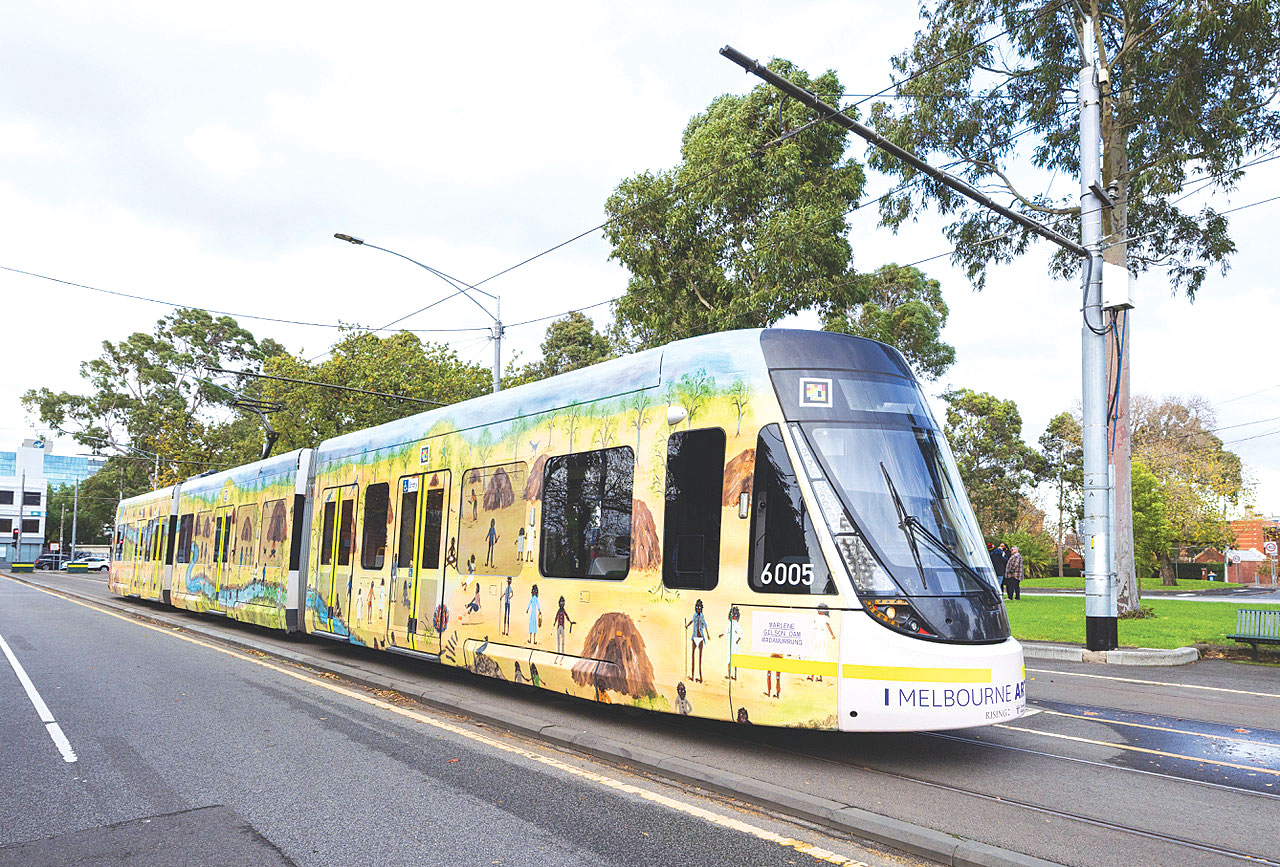
The Legacy Tram honours Wadawurrung Elder and senior artist Marlene Gilson OAM. Picture: James Morgan Photography.
MELBOURNE’S trams have become moving works of art once more, as the First Peoples Melbourne Art Trams return to the city’s streets. Over the coming weeks, six newly-wrapped trams enter the world’s largest tram network, each transformed into a moving canvas by Aboriginal artists with connections to Victoria.
Curated by Taungurung woman Kate ten Buuren, the 2026 edition celebrates the power of Blak imagination, bringing together six works that convey the limitless possibilities of First Peoples imagining. Travelling across the city for the next 12 months, the trams carry stories of Country, memory, resistance, futurity and cultural continuity through Melbourne’s public spaces.
Leading this year’s launch is the 2026 Legacy Tram which honours Wadawurrung Elder and senior artist Marlene Gilson OAM, whose multi-figure paintings reclaim and re-contextualise the representation of historical events.
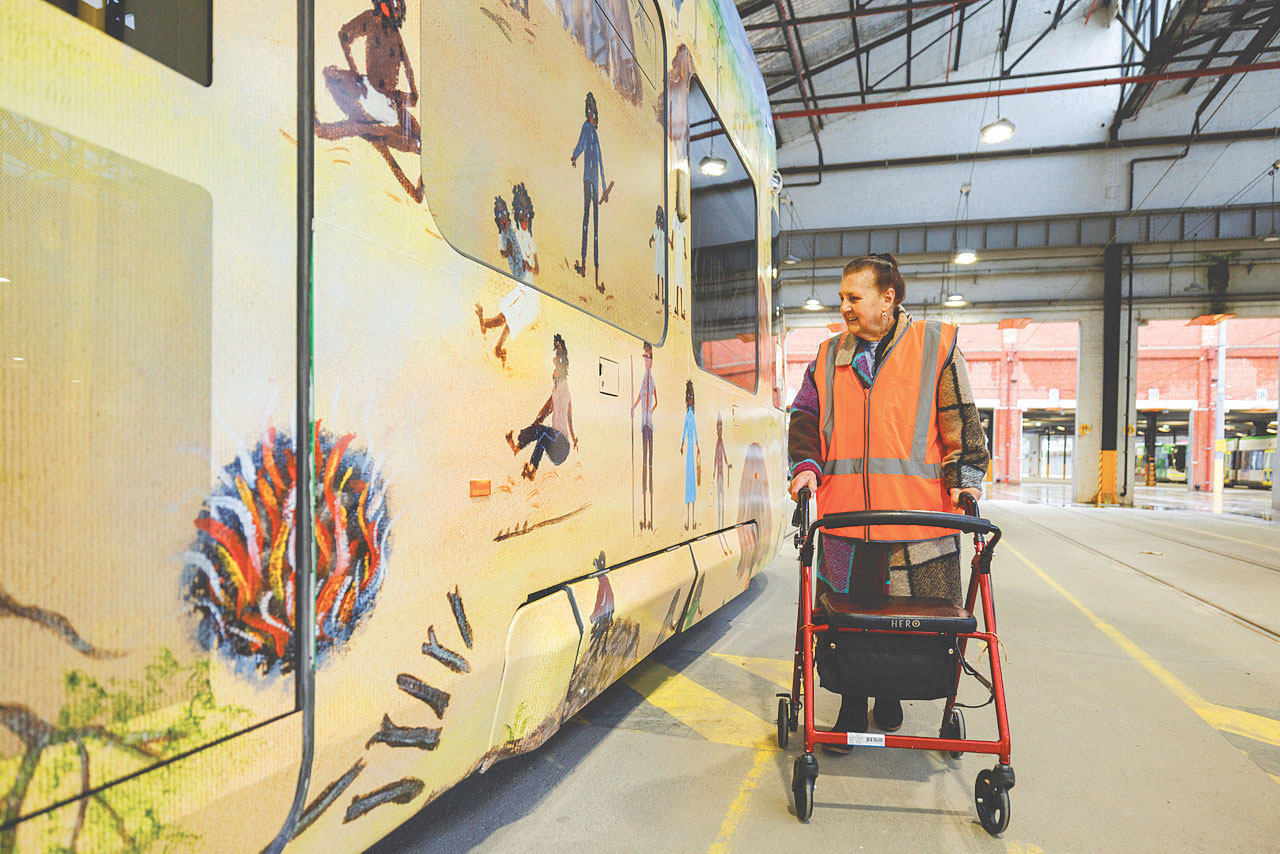
“Today we unveil the first of six First Peoples Melbourne Art Trams for 2026, presenting senior Wadawurrung artist Aunty Marlene Gilson’s Happy Families – time when we all lived together, and Aunty Marlene has made significant contributions to community through her arts practice and her ability to reframe dominant historical narratives in her paintings,” said Kate ten Buuren.
“Happy Families transports us through time and space, and lands us on the riverbank, where families are thriving; caring for one another, dancing, fishing and practising culture together.
“The five trams that will be launched next also reflect on time, memory and First Peoples relationships to Country and the beyond. Together they demonstrate the limitless possibilities of our imagination.”
Centred on stories relating to her ancestral lands, spanning Ballarat, Werribee, Geelong, Skipton and the Otway Ranges, Gilson’s work overturns the colonial grasp on the past, reasserting First Peoples perspectives through richly-detailed scenes that hold history, culture and Country together. Often featuring her two totems, Bunjil the eagle and Waa the crow, her paintings reconfigure historical narratives while revealing a profound spiritual connection to Country.
Gilson’s practice has earned national and international acclaim, carrying her stories of Wadawurrung Country to the world stage. She has presented solo exhibitions in Ballarat, Melbourne and Sydney, participated in group exhibitions internationally, and was invited to exhibit in the 60th Venice Biennale in 2024. That same year, she was awarded a Medal of the Order of Australia, recognising her significant contribution to the visual arts.
In 2018, she was commissioned for the 21st Biennale of Sydney, while in 2021 her work lit up the sails of the Sydney Opera House for Badu Gili: Wonder Women, a major projection celebrating six Indigenous women artists from across the continent.
Now, her work moves through the city as part of Melbourne’s most visible and longest-running public-art initiatives, transporting First People’s art, history and imagination beyond gallery walls and into the everyday rhythms of public life.
Alongside Gilson’s Legacy Tram, the 2026 First Peoples Melbourne Art Trams features artworks by Natasha Carter (Dja Dja Wurrung, Yorta Yorta and Jaru), Mitch Mahoney (Boonwurrung and Barkindji), Jenna Mayilema Lee (Larrakia, KarraJarri, Wardaman), Zena Zada Cumpston (Barkandji/Kurnu) and Sonja Hodge (Lardil).