DeadlyScience championing STEM education in remote communities
STEM – science, technology, engineering and maths – education in remote communities.
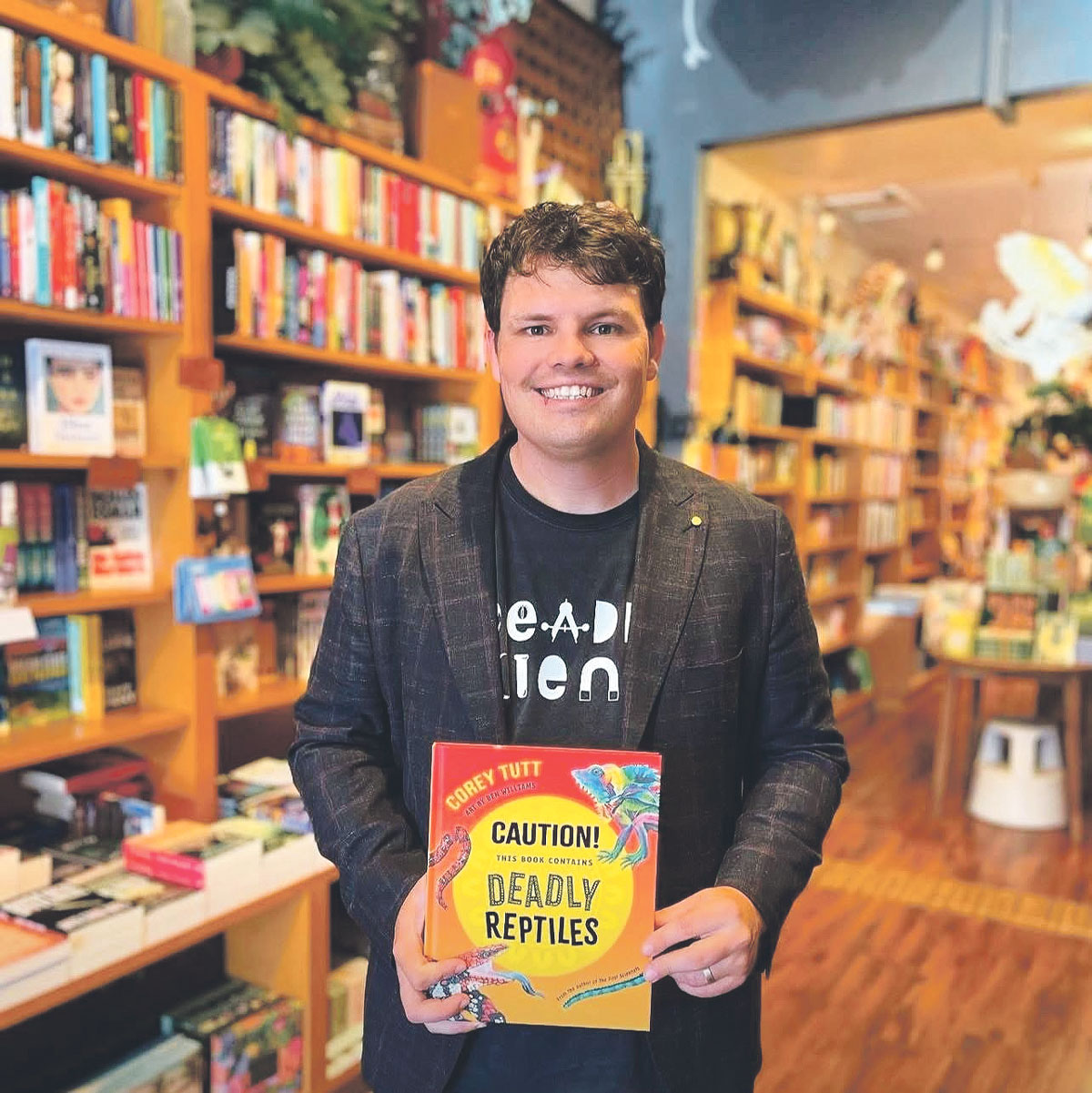
Corey Tutt OAM with his book, Caution! This Book Contains Deadly Reptiles.
By MARION WILLIAMS
Corey Tutt has already achieved so much but he is very motivated to continue his hard work that is having a profound impact on many young Aboriginal people. Before he turned 30, the founder of the charity DeadlyScience was awarded a Medal of the Order of Australia for championing STEM – science, technology, engineering and maths – education in remote communities.
Prior to that he was the 2020 NSW Young Australian of the Year. In 2021 he won a Eureka Prize, science’s equivalent of an Oscar. He is an award-winning author and an associate professor at Western Sydney University.
Yet the Kamilaroi man had a “pretty rough childhood” growing up in Dapto when “there was a lot of biases.” At aged 16, he left home to work at a wildlife sanctuary in Western Australia. On his return, he worked at Nowra Wildlife Park. Tutt spent two years shearing alpacas where he met a chemical engineer James Dixon who he credits with saving his life after losing a very close friend to suicide.
After a stint working at the RSPCA with rescue dogs, he got a traineeship at the Garvan Institute of Medical Research. He learnt how to make mice for medical research using genetic mapping and qualified as an animal technician. Then, as a lab manager at the University of Sydney, he started going to Redfern and yarning with kids about science and animals.
“That’s what DeadlyScience came from. I was in my mid-20s and wanted to do more with my life and solve some of those problems,” Tutt said. “There are a lot of smart kids out there who didn’t believe they could do what they wanted to do.”
He began researching remote schools and their STEM programs.
Tutt was so sad to hear one school only had 15 books that he bought STEM resources – books and equipment – out of his own money and sent them out. He took on a second job when he ran out of money. When the money ran out again, he started a GoFundMe campaign.
From those beginnings in 2018 he has built DeadlyScience without any government funding.
He and around 32 First Nations and non-First Nations employees send STEM resources across the country, visit schools and run STEM workshops. DeadlyScience now runs several programs including the Deadly Pathways program that gets Indigenous kids into STEM.
Without Deadly Pathways, students like Rilee Webber would find it very hard to get into STEM. She is studying for a pharmacy degree and is a DeadlyScience ambassador.
Deadly Labs offers culturally relevant STEM education through hands-on kits developed in collaboration with Indigenous communities and Elders, including one sent to juvenile-justice centres across Australia. It was co-designed by nine inmates at ACMENA Youth Justice Centre. Another Deadly Labs’ kit is bush soap.
“They prevent rheumatic heart fever and other diseases by making soap equitable,” Tutt said. “We teach kids how to wash their hands and put soap into every household. It isn’t trying to cure, but to prevent.”
Away from DeadlyScience, Tutt wrote the world’s first reptile book that uses Aboriginal names. It is included in the clinicians’ guide to treating snake bites. His award-winning book The First Scientists teaches young people that not all scientists are white males in lab coats. He won’t stop working hard so he can leave his son a legacy.
Tutt is proud that DeadlyScience’s employees come to do a job that they love with a smile on their face, make a difference to thousands of kids and get the same joy that he does from seeing kids’ faces light up. He credits his grandfather for teaching him that his best is good enough.
“Effort and determination always trump talent,” Tutt said. “Working hard for others is the ultimate reward.”