Questions remain after long fight for justice for Mark Haines
“We’ve always maintained the fact that, if Mark was a white boy, we believe that there would have been more effort put in to find out what happened to him.”
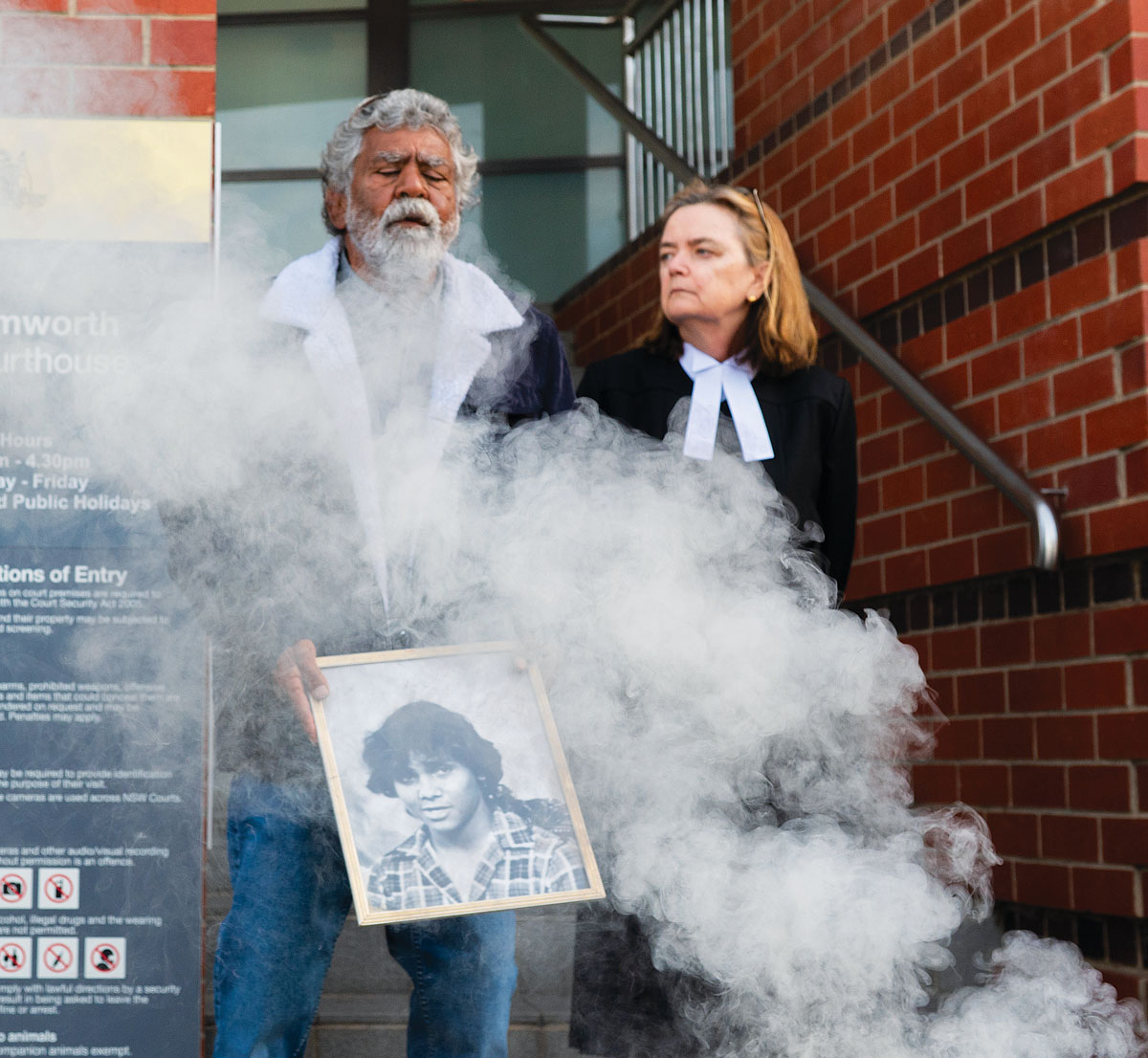
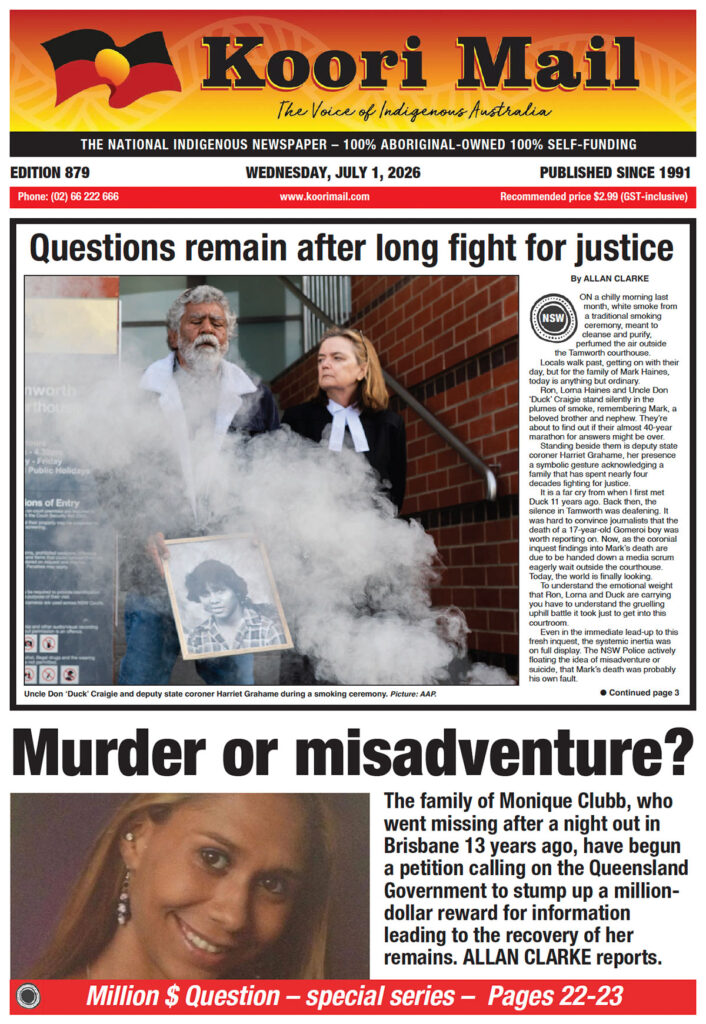
Uncle Don ‘Duck’ Craigie and deputy state coroner Harriet Grahame during a smoking ceremony. Picture: AAP.
By ALLAN CLARKE
On a chilly morning last month, white smoke from a traditional smoking ceremony, meant to cleanse and purify, perfumed the air outside the Tamworth courthouse. Locals walk past, getting on with their day, but for the family of Mark Haines, today is anything but ordinary.
Ron, Lorna Haines and Uncle Don ‘Duck’ Craigie stand silently in the plumes of smoke, remembering Mark, a beloved brother and nephew.
They’re about to find out if their almost 40-year marathon for answers might be over.
Standing beside them is deputy state coroner Harriet Grahame, her presence a symbolic gesture acknowledging a family that has spent nearly four decades fighting for justice. It is a far cry from when I first met Duck 11 years ago. Back then, the silence in Tamworth was deafening.
It was hard to convince journalists that the death of a 17-year-old Gomeroi boy was worth reporting on. Now, as the coronial inquest findings into Mark’s death are due to be handed down a media scrum eagerly wait outside the courthouse. Today, the world is finally looking.
To understand the emotional weight that Ron, Lorna and Duck are carrying you have to understand the gruelling uphill battle it took just to get into this courtroom. Even in the immediate lead-up to this fresh inquest, the systemic inertia was on full display.
The NSW Police actively floating the idea of misadventure or suicide, that Mark’s death was probably his own fault.
For the family, this narrative has been a form of institutional gaslighting they’ve fought hard to counter.
They knew Mark, a charismatic teenager who adored his family, would never willingly lie down in front of a train.
“We never believed in our hearts that Mark took his own life and today the coroner made that official,” Ron and Lorna said in a joint statement. “We’ve always maintained the fact that, if Mark was a white boy, we believe that there would have been more effort put in to find out what happened to him.”
When the inquest got underway in April 2024, it became a two-year process. Five intense weeks of testimony were punctuated by long gaps. Every time a session wrapped up, the family were left stranded and without support.
Inside the packed courtroom, as deputy state coroner Harriet Grahame prepared to read her 200-page finding, the clinical legal jargon that often strips the humanity away from Indigenous victims, was cast aside.
The family refused to let Mark’s memory be reduced to a boy on the tracks. Ron stood up and read a moving poem about his hero, his big brother. Lorna spoke through a lifetime of tears, choosing not to talk about politics or police failures, but about the brother she missed.
As the coroner laid out the written findings, she called the initial investigation deeply flawed, superficial, and inadequate from the outset.
On that early January morning in 1988, Mark was found with a catastrophic head injury. Yet, there was very little blood on the tracks, and a towel appeared to have been placed under his head. Nearby sat a smashed-up Holden Torana.
The initial police report failed to connect any of these dots. The car was never fingerprinted, and it was left exposed the elements before disappearing. The investigation was closed in just 38 days.
The coroner acknowledged that racism and unconscious bias within the system played a defining role in the handling of the case, explicitly stating that it was highly unlikely a white teenager’s death would have been treated with such lacklustre indifference.
Because that crucial evidence was lost or destroyed in 1988, coroner Grahame admitted with “deep personal regret” that a definitive answer on exactly how Mark died remained just out of reach. She also remained unconvinced that key witness Glenn Mannion had shared everything he knew about Mark’s death. Then came the ruling that vindicated the families claims that Mark had not done this to himself.
The coroner officially ruled out suicide and referred the case to be looked at by the NSW state crime command’s unsolved homicide unit.
As the findings were read out, those sitting behind Uncle Duck in the court noticed a physical shift in him. His tense shoulders relaxed and his eyes widened, he relaxed for the first time in a very long time. After years of being a thorn in the sides of authorities, the coroner acknowledged his tireless fight for justice.
“Well the journey doesn’t end here, but it feels like progress. We will never stop until we know what happened to our boy,” Duck said, adding, emotionally, that “he (Mark) was worth it… he was worth it.”
While the family didn’t get all the answers to their questions, as Uncle Duck, Lorna, and Ron walked outside, they walked out with something the state had denied them for a long time, validation.
“Because he was black, [the police] didn’t care about him,” Lorna told the media outside the courthouse. “What we went through, we are still going through… but we never lost hope.”