Studio a place for young people
GOMEROI rapper Kobie Dee is once again pushing the boundaries with his latest project, a community-led recording studio on Bidjigal Land (Maroubra, Sydney).
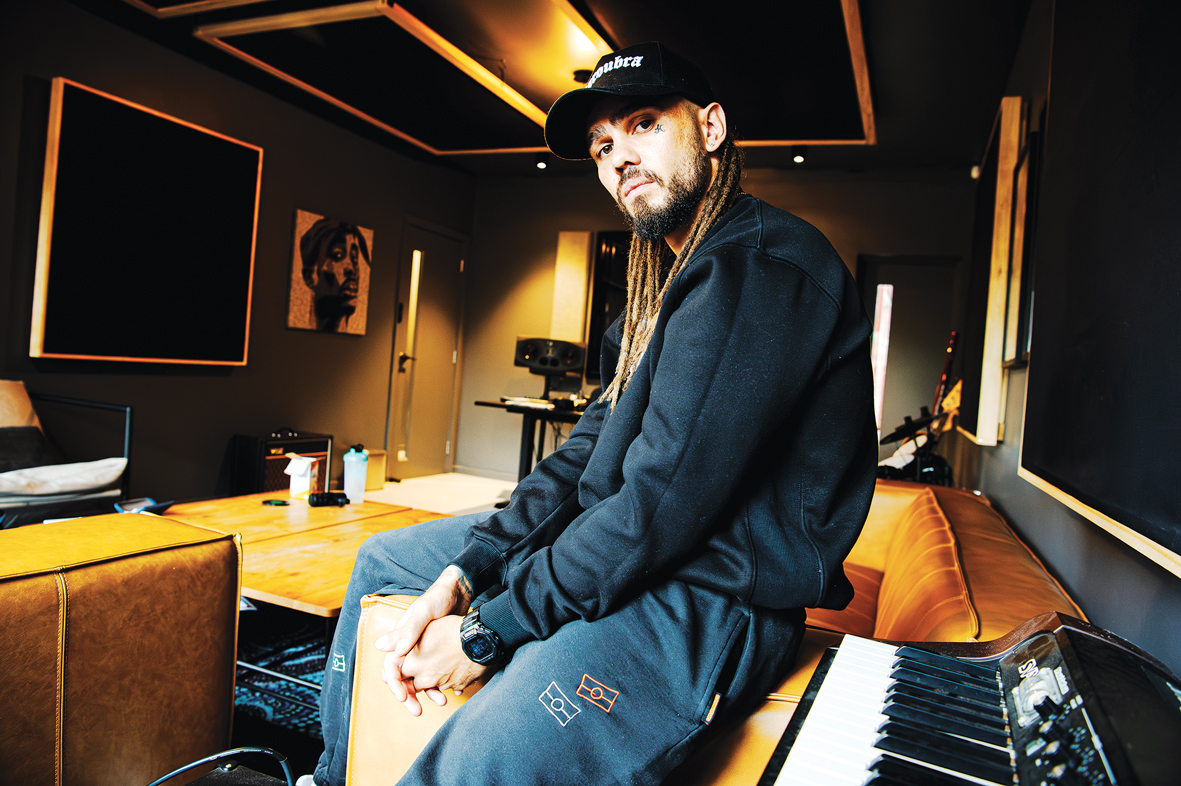
Kobie Dee n twenny47 studio. Picture: supplied.
By ALI MC
Founded on the principles of self-determination, Twenny47 Studios is located in his old neighbourhood at Lexington Place, where he grew up.
Dee told the Koori Mail he established the studio to support “the opportunity for other young people with the dreams that I had and show that it can happen.”
“You need to believe that you can be bigger than what your wildest dreams are,” he said.
Supported by Nakama Arts, and sponsored by the audio company Technical Audio Group, Dee said the studio is the “dream partnership”.
Not only did the company purchase the building and supply the equipment, they also gave the rapper a free reign of the design and running of the studio and gallery space.
“They’re not telling me how to run things. They’re like, ‘you tell us what you need, and we’re there,’” he said.
Nakama Arts has already established a similar studio in Bourke, where Dee connected with the company as a youth worker.
“I remember going to Bourke, and there’s just nothing going on. During the day, it’s like a ghost town,” he said.
“And now they’ve put this studio in there, which has a barber shop at the front. They’ve got a cafe, they’ve got a t-shirt printer where they make their own T-shirts. They’ve got a studio at the back, and it’s all run by community members.”
While Twenny47 Studios has been up and running for two years, Dee only recently launched the project publicly.
“I wanted it just to be local kids to start with. So for a full year, I didn’t promote it. It was literally word of mouth. I just told them and their parents because I know heaps of the young kids’ parents, I grew up with them,” he said.
“I was telling them, I’ve got the workshops on these days. So they would just ring the doorbell, and sometimes we’d have 20 kids come through.”
Dee said he was motivated to set up the studio based on his own experience as a young person who had dreams of becoming a rapper but no real way to realise those dreams.
“I used to try and set up with the SingStar PlayStation. I’d put my bed mattress up and that’s how I used to try and record when I was a kid,” he said.
“But now these kids get to have proper studio where they can make a proper song. That’s what motivates me to do this, to show them what’s possible.”
He said that it was important for First Nations young people to understand that creativity is a cultural practice stemming back thousands of years.
“For blackfullas we’ve been creating for thousands of years. We didn’t have written books, scripts and all that,” he said.
“Everything was speaking, word of mouth, stories, art, dance song. Why would we stop that for our young blackfullas?”
Twenny47 Studios features a fully-equipped recording studio and a podcast room upstairs, with plans to transform the large downstairs space into a gallery and performance area.
Dee hopes that by offering an opportunity to be creative in a non-formal environment, it will encourage young people to explore their potential.
Dee said one of the major challenges facing First Nations children and young people was the impact of juvenile detention and prison, which rather than acting as a deterrent, had instead become a rite of passage for many.
He recalled how he felt a sense of achievement the first time he was locked up in the police cell as a teenager.
“When I was a kid in that cell the first time I was like, ‘all right, I’m halfway there. This is my start now,’” he said.
“It’s such a weird way to look at it now.”
He said the positive influence of his mum steered him away from committing further crime that would have seen him eventually locked up in adult prison.
“My mum always made sure we had food on the table, we had food in the cupboard. Always had clothes on my back,” he said. “I knew that if my mum knew what I was doing, she’d be very disappointed, she’d be very angry.”
Dee said he hopes that offering the facilities at Twenny47 Studios will deter children and young people away from becoming just another statistic to prison, drug addiction and youth suicide, all factors that he faced growing up.
“By the time I was 19, I had lost five friends to suicide, just in this park down here. I turned 22 in rehab. I had just had my daughter,” he said.
“I was young, and it was the right time for me to really change and focus on this.”
“If I can create this opportunity for young people before they get to that point in their lives, that’s where a lot of this comes from.”
He said that exposing First Nations young people to hip-hop, art and business will help instil a sense of purpose in life, just as he had with his make-shift SingStar studio in the bedroom.
“I was lucky that I found my purpose early on and I knew what I wanted to do,” he said. “A lot of these youngfullas are lost and I was lost. I was very lost. But I knew I wanted to be a rapper.”